

Walk into any boardroom discussion about operating costs today, and electricity is almost always on the agenda. For Indian businesses, power bills have quietly become one of the heaviest recurring expenses, and unlike many other costs, they seem to go only one direction: up. Rising tariffs, demand charges, and unreliable supply have led many business owners to look seriously at alternatives.
Rooftop solar has become an alternative for thousands of commercial establishments across India. And the reason it is gaining ground is simple: the financial case actually holds up. Most commercial rooftop systems today recover their cost within 3 to 5 years and then continue generating power for another 20 or more years. For many businesses, the conversation has moved on from “does solar work?” to “which partner do I trust to get this right?
Why Commercial Solar Makes Financial Sense in India
The business held back due to a large upfront commitment with returns that were hard to verify. That hesitation was understandable, but the ground reality has changed significantly over the last few years.
Panel manufacturing prices have dropped significantly, system efficiency has improved, and grid tariffs have continued to rise. The combination has made rooftop solar genuinely attractive to businesses, not just an environmental gesture. Industry standards for commercial and industrial installations in India today show payback periods of around 3 to 5 years, depending on your state tariff, system size, and whether you go for outright purchase or a financing model.
Once you recover the initial cost, the savings continue for the remaining life of the system, which is typically 20 to 25 years for modern installations. Studies focused on business solar projects in India indicate internal rates of return in the range of 18 to 22 percent, which compares well against many conventional investment options. Over the full system life, businesses can reduce their electricity spend by 60 to 80 percent on the portion of load served by solar. That is a number that gets attention in any finance review.
JAKSON Solar: A Rooftop Specialist Worth Knowing
JAKSON Solar is part of the JAKSON Group, which is a recognisable name in Indian energy infrastructure for decades. The group has presence across solar, EPC services, and industrial power solutions, with its own solar PV module manufacturing facility in Greater Noida.
Within the rooftop solar space, JAKSON has built a strong position as one of India’s leading companies for commercial and industrial applications. Their projects range from systems around 100 kilowatts all the way up to multi-megawatt installations, which cover most commercial requirements in the country.
What sets them apart for many buyers is the turnkey model. JAKSON handles engineering, procurement, construction, and grid integration as a partner. That matters in practice because coordinating multiple vendors on a rooftop project creates delays, accountability gaps, and cost overruns. When one experienced company owns the entire process, you get cleaner timelines and a single point of contact when something needs attention.
The ROI Levers That Matter for Indian Businesses
JAKSON highlights several financial benefits that are particularly relevant for Indian commercial and industrial users.
- Reduction in power bills: A well-designed rooftop plant can cut electricity costs by up to 70 percent on the load it serves, depending on your consumption pattern and applicable tariffs.
- Payback in 4 to 5 years: JAKSON’s commercial proposition is built around this timeframe under standard cost and tariff conditions for Indian businesses.
- Returns above 20 percent: The company cites potential ROI exceeding 20 percent, which sits comfortably within current market estimates for business solar in India.
- Accelerated depreciation: Commercial entities can typically claim around 80 percent depreciation on the project cost within the first two years, which improves post-tax returns and effectively reduces the net investment.
- Net metering and policy support: State net metering regulations and central government schemes, where applicable, provide additional financial upside and shorten the effective payback period.
Taken together, these factors turn a capital-intensive decision into a structured, long-term savings on your energy costs. That is a different way of looking at a rooftop than most businesses are used to.
What the Numbers Look Like in Practice
Every project is different, and actual returns depend on your state tariff, roof characteristics, load profile, and financing approach. That said, published commercial case studies from across India give a useful reference point.
A midsize commercial rooftop system, once subsidies and depreciation are factored in, can generate annual savings equal to roughly one-quarter to one-third of the initial investment every year. Over a 25-year system life, that compounds into cumulative returns several times higher than the original outlay. JAKSON’s own project communication reflects this, pointing to up to 70 percent savings on electricity, payback in 4 to 5 years, and returns above 20 percent for clients whose systems are correctly sized and maintained.
The Benefits That Go Beyond the Spreadsheet
Financial returns are the primary driver for most commercial solar decisions, and rightly so. But there are operational benefits that business owners often mention once a system is running.
The most practical one is control. When you generate a portion of your electricity on-site, you are less dependent on grid availability and less exposed to future tariff increases. For facilities with high daytime loads, such as factories, retail floors, hospitals, and office buildings, solar generation tends to align well with peak consumption hours, which maximises self-consumption without needing complex storage solutions.
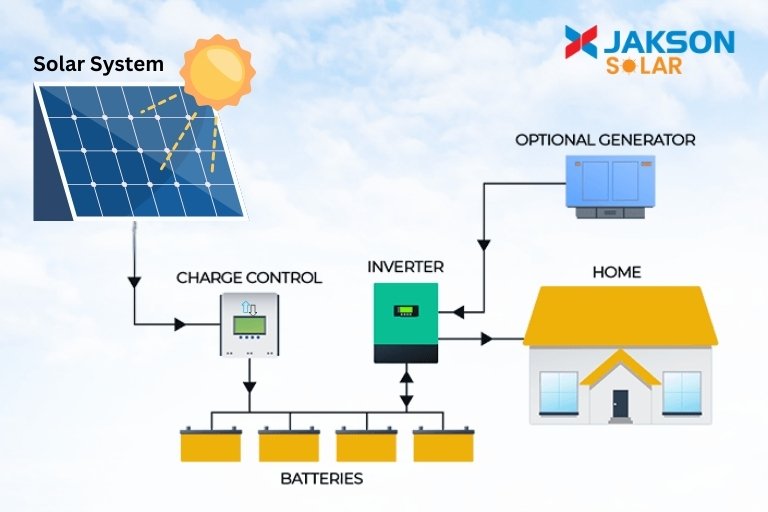
JAKSON emphasises seamless integration with existing electrical infrastructure as part of their design approach. This means solar supports your operations as a natural part of the system rather than as a separate setup that requires extra management.
There is also the brand dimension. For businesses that work with large enterprise clients or export-oriented supply chains, visible investment in clean energy increasingly carries weight in vendor assessments and procurement conversations.
Why Indian Businesses Choose JAKSON Solar
JAKSON Solar brings together module manufacturing, rooftop engineering, and project execution under one roof. For clients who want a single accountable partner rather than handling multiple vendors, JAKSON Solar is a practical advantage.
The group’s experience across diverse geographies and applications in India, from industrial facilities and logistics parks to hospitals and educational institutions, means their teams have worked through most of the site-specific challenges that arise in real projects. That experience shows up in design decisions, grid compliance, and post-commissioning support.
For any business with a viable roof, daytime power consumption, and an interest in reducing long-term energy costs, a detailed site assessment with an experienced company like JAKSON Solar is a logical starting point. The ROI potential is real, but the numbers that matter most are the ones calculated for your specific tariff, load, and roof area. The sooner you get that assessment done, the sooner you can make a decision based on facts rather than estimates.