Solar Cells Powering a Smarter, Sustainable Future

Innovation-driven solar cell technologies delivering higher efficiency, reliability, and performance for tomorrow’s energy needs.

solar cell jaksonsolar
India adds record 25 GW renewable capacity in April Sep 2025

What is a Solar Cell?

As the world shifts towards renewable energy, Solar PV is becoming smarter, more efficient, highly adaptable and flexible. Whether it’s powering homes, factories, farms, or even remote villages, solar energy is shaping a greener tomorrow. Backed by constant innovation, supportive policies, and growing awareness, solar PV is not just a technology-it’s the future of sustainable living.

A solar cell, also known as a photovoltaic cell (PV cell), is an electronic device that converts the energy of light directly into electricity by means of the photovoltaic effect. It is a form of photoelectric cell, a device whose electrical characteristics (such as current, voltage and resistance) vary when it is exposed to light.

How Does a Solar Cell Work?

From Sunlight to Electricity

A solar cell works on the principle of light absorption and charge separation. When photons from sunlight strike the silicon surface, they generate electron-hole pairs. The built-in electric field at the p-n junction separates these charge carriers, directing them to flow in opposite directions. Once connected in a circuit, this movement produces an electric current. As the fundamental unit of solar modules, Solar cells play a vital role in photovoltaic power generation.

How solar cell work jaksonsolar

Figure 1. Scheme of a Typical Solar Cell.

Advancement in Solar PV Technologies

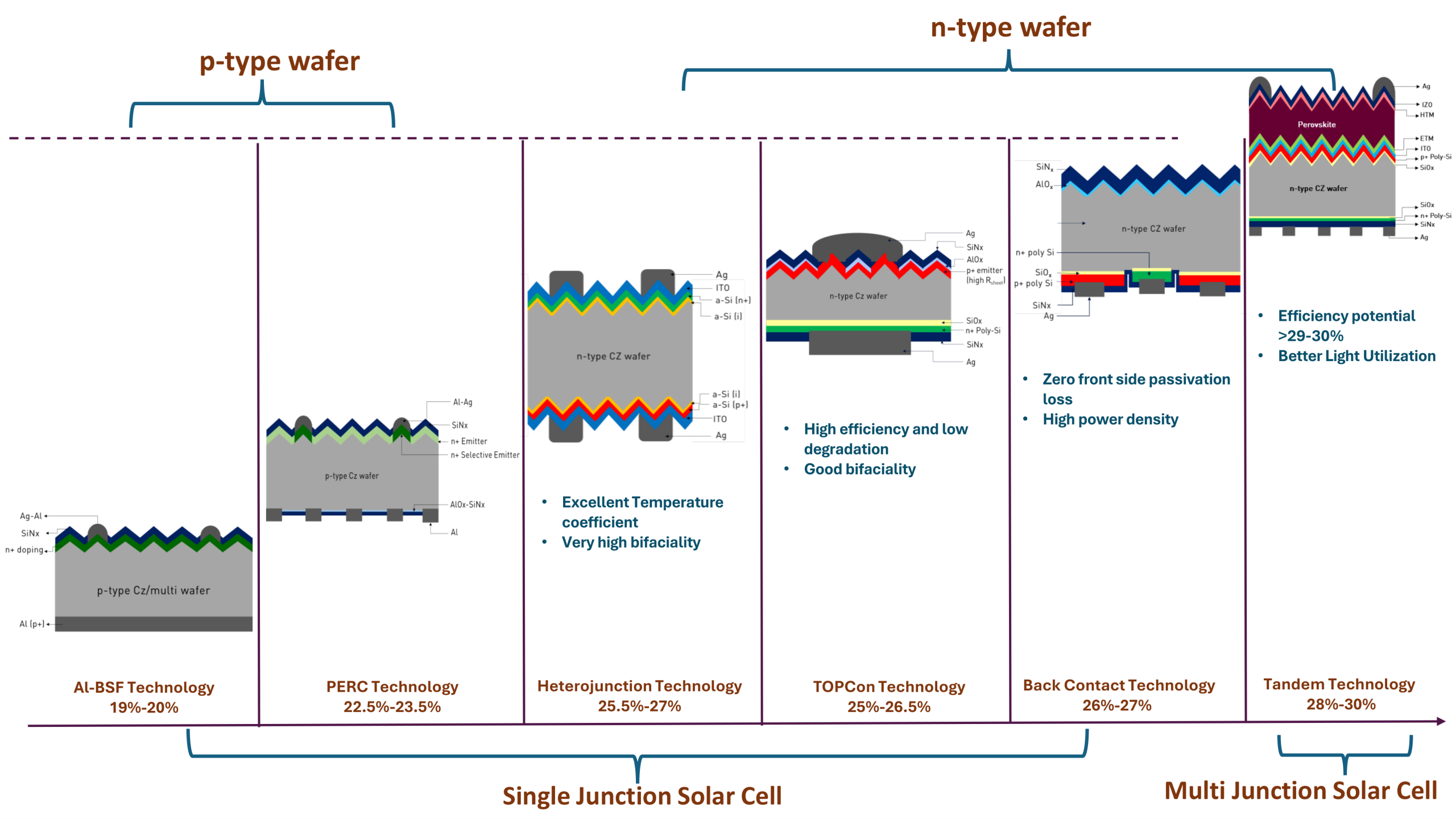
Since the early development of conventional solar cells, PV technology has advanced significantly. In recent years, innovations such as Passivated Emitter and Rear Cell (PERC), Tunnel Oxide Passivated Contact (TOPCon), heterojunction (HJT) back contact (xBC), and Tandem solar cells have pushed the boundaries of efficiency. These cutting-edge designs enable higher power generation from the same amount of sunlight, making solar energy more efficient, accessible, and cost-effective than ever before.

Transition of Solar cell technology version2

Figure 2. Schematic diagram of the evolution of c‐Si solar cells. The efficiency data presented is based on laboratory or industrial data from recent years.

TOPCon: Powering the Next Era of Solar Efficiency

TOPCon (Tunnel Oxide Passivated Contact) solar cells represent the advanced step in
solar innovation. They are designed to deliver higher efficiency and long-term reliability.

The secret lies in their advanced rear-surface design: an ultra-thin tunnel oxide layer
combined with a doped polysilicon layer. This structure allows electricity to flow smoothly while preventing energy losses caused by recombination.

solar cell topconpng

Figure 3. Schematic of TOPCon cell

Layer by Layer view of TOPCon Cell solar module

Figure 4. Layer by Layer view of TOPCon Cell

Why the World is Moving Towards TOPCon Technology

fabrication process of Topcon cell

Figure 5. Fabrication process of TOPCon cell

PRODUCT FEATURES

High-Efficiency Bifacial Solar Panels
Higher Efficiency
25.5-26.0%
(≥27% potential)
↕️
Higher Bifaciality
80-85%
🌡️
Improved Power Temperature Coefficient
-0.29%/°C
🛡️
Low LID /Low Degradation
0.35-0.4%/year
🔬
Rear Passivation
Premium Tech

G12R: Unlocking Higher Power in TOPCon Technology

Type
Cell Size
Efficiency (%)
Power per cell (Wp)
No of Busbars
G12R
182.3*210mm
25.5
9.75
16
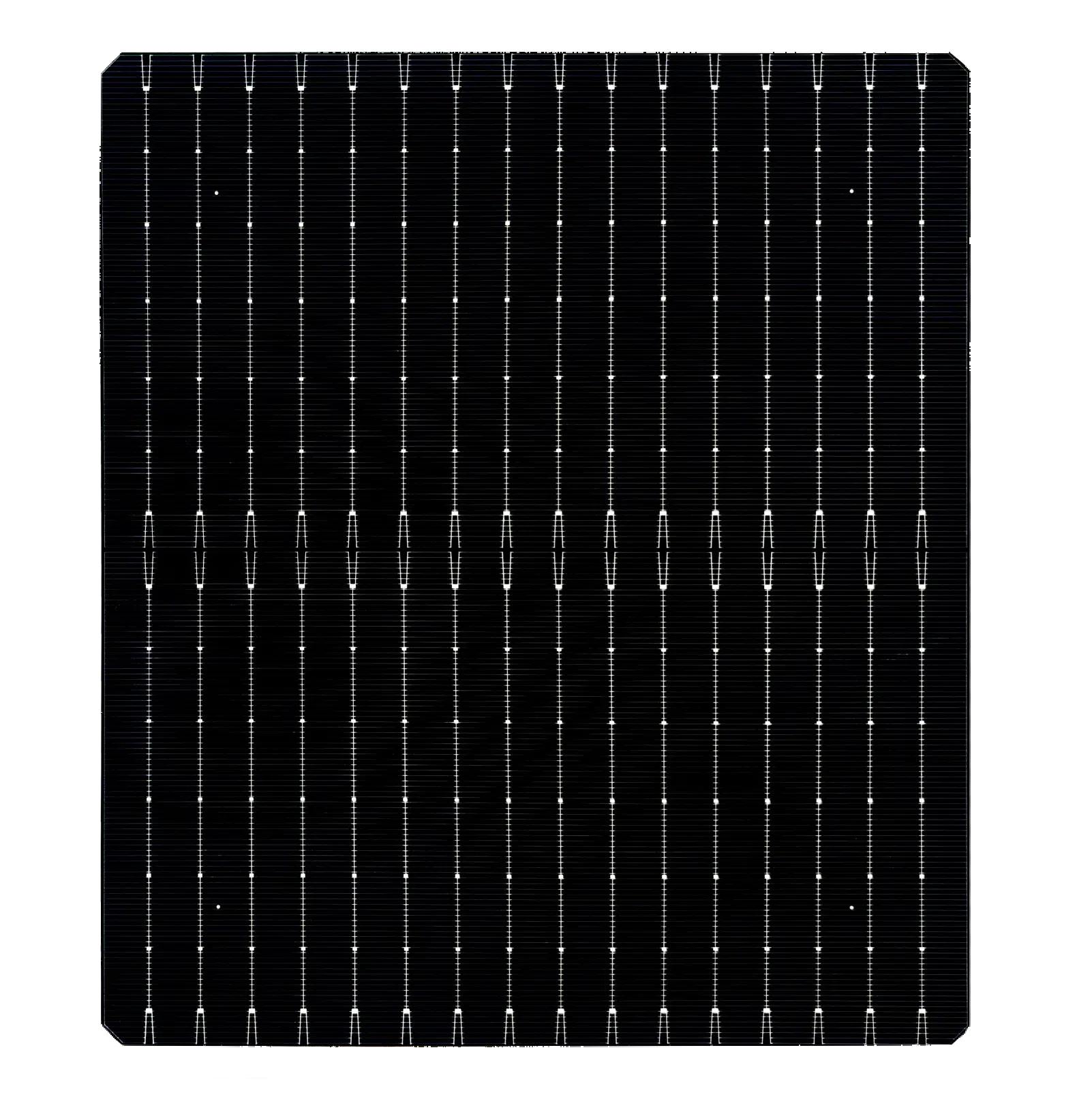
G12R solar cell

G12R

From the Himalayas to the coastlines, from rooftops to farmlands – India’s Sunshine turns every space into Solar potential.

We at Jakson Solar proudly announce the start of construction of our integrated 6 GW Solar PV manufacturing facility in Madhya Pradesh, India. In Phase I, we will establish 3 GW of Solar modules and 3 GW of TOPCon Solar cells, with the first batch of modules rolling out by Q2 2026 and cells by Q4 2026. Subsequent Phases will include backward integration into ingots and wafer production while further expanding Solar module and cell manufacturing.

This expansion is more than just numbers – it is a promise to India’s renewable energy future, built on world-class efficiency, sustainability, affordability, and innovation, reflecting our unwavering commitment to a brighter and greener tomorrow.

As we move forward on the journey of sustainability, affordability, and versatility, our new manufacturing plant will feature cutting-edge facilities that reflect Jakson’s vision and collaboration towards building a cleaner and greener future for the nation.

Why G12R…?

G12R solar cells excel with

  • Higher Current and Higher Power (Wp)
  • Better efficiency (%)
  • Better performance at high temperature
  • Space and Cost Saving: Fewer modules as module give higher power on same
    footprint, saving space and lowering BOS.
Electrical Characteristics (STC)
Efficiency (%) Pmpp (Wp) Impp (A) Vmpp (V) Isc (A) Voc (V) FF (%)
25.79.8315.260.64415.6270.73985.12
25.69.7915.2250.64315.5910.73885.08
25.59.7515.18690.64215.56020.73785.02
25.49.7115.14820.64115.53020.73684.95
25.39.6815.1250.64015.51790.73584.87
25.29.6415.08610.63915.48760.73484.80
25.19.6015.0470.63815.44620.73384.79
25.09.5615.00780.63715.4120.73284.74
24.99.5214.96860.63615.37760.73184.69
24.89.4814.92910.63515.3430.73084.64
24.79.4514.90540.63415.32450.72984.59
24.69.4114.86570.63315.29140.72884.53
24.59.3714.82590.63215.25640.72784.48
24.49.3314.78610.63115.2230.72684.42
24.39.2914.7460.63015.18760.72584.37
24.29.2514.70590.62915.15390.72484.31
Thermal Rating (Temperature Coefficient)
Temperature Coefficient of Isc (α) 0.046%/K
Temperature Coefficient of Pmax (γ) -0.30%/K
Temperature Coefficient of Voc (β) -0.25 %/K